The golden quadrilateral project was a landmark in the history of Indian highways. Since then no such big project was implemented for Indian Highways. In India the highways though efficiently built are in a very pathetic state. These highways should be categorized into national highways (connecting metropolitan cities), state highways (connecting second class cities), district highways (connecting towns and villages). These highways should never criss-cross one another in a X-ing manner to prevent slowing down of traffic by one type of highways to the other. They should meet at certain points efficiently so that the traffic speed does not get hindered.
Some of the main points we should keep in mind for highways: -
1) There should be separate highways for private cars / buses and trucks (freights).
2) Speed limit should be fixed and in no case should be brought down or up unnecessarily.
3) There should be bye-lanes along the highways near towns and cities so that the daily traffic of these places should not get inside highways.
4) If possible the highways should be elevated if it passes through a city or town to prevent traffic.
5) Proper bus services should be introduced connecting big cities, small cities and towns.
6) No political / social demonstration should be allowed on highways.
7) Slow moving traffics should not be allowed in highways.
If these basic points are followed properly (there are many more), only then we can introduce big projects like bus and other transport systems that can travel through these highways at speeds close to 400 kms / hr. Similarly dedicated elevated lines for rapid transit of trains between big cities can be introduced if given a proper thought. (according to my last to last post)
Visitors till this post: 53050 visitors
You are Visitor No
Showing posts with label Political. Show all posts
Showing posts with label Political. Show all posts
Wednesday, October 19, 2011


Sunday, May 15, 2011
Change in Bengal Politics
Bengal Politics has seen a big change from Left Rule to the TMC Rule on 13th May, 2011. It was a Friday. Friday the 13th which was unlucky for the Left Parties who had been ruling Bengal at a stretch for 34 years. Almost three and a half decades ruling a state in India is not a joke. One needs to have character to do so. Left had that under Jyoti Basu for about 24 years and then 10 years under Buddhadeb Bhattacharya. Now, Mamata Banerjee will sworn in as the new Chief Minister of Bengal on 18th May at the Brigade Parade Grounds. People have a lot of expectations from her and some even dreamt of her to be the next Bidhan Chandra Ray under whom Bengal had experiences all around development.
It feels bad for Buddhadeb Bhattacharya who was an able administrator but one wrong step by him (allowing the police to shoot at the villagers of Nandigram) made his government loose the Lok Sabha and now the Bidhan Sabha elections in 2010 and 2011 respectively.
Congratulations to Mamata Banerjee would be too less to admit and acknowledge her perseverance and ability to fight against all odds. She started from a mere party worker and beating MP Somnath Chatterjee from his own constituency to Rail Ministry (a couple of times) to the present post of Chief Minister of Bengal. It is definitely a long way and only time will tell if she can be successful in being an able administrator who can drive Bengal from poverty, debt to the most prosperous state in future and retaining the long lost glory of Bengal.
Left Party (CPIM) did a lot of work for Bengal in terms of farming, panchayat system, infrastructure and cultural areas but was a total failure in economy, healthcare, education and job market creation. Thus Bengal could no more be called a state which thinks matters one day ahead of the rest of India (“What Bengal thinks today, India thinks tomorrow”). It is a matter of time to see whether Mamata can revive Bengal to a different revolution of overall development that her party’s manifesto promises.
Visitors till this post: 47154 visitors
Friday, April 01, 2011
Inhuman Working Hours
After working for 2 telecom companies in last 2 years, what I have come to understand is that inhuman working hours are on a rise among the present employees. It is not only restricted to telecom companies. Modern day employees are robbed off from their rest, social duties by promises of extra salaries and perks. Modern day employees are ready to be fooled by such companies only to get some extra money. They work from 9:00am in the morning to 12:00midnight at a stretch even if they are reluctant to do so. It is like robbing them of their basic fundamental rights of getting peace and mental rest. They are also made to work 6 days a week and in most cases they are not paid much for an extra day work. Even they are called on Sundays to work thus making them a mere doll in the hands of employees.
To stop such inhuman activites by the employers the employees should appeal in the court of law or in parliament and pass a bill to reduce working hours to a fixed of 8 hours and 5 days a week. Only them present day generation will get time to mingle with the society and have mental peace and rest which they lack leading to all sorts of mental disorders and health deterioration. These are also leading to unhappy relations with spouses, divorce cases and even suicide and murders.
Employees cannot have proper relationships with their spouses and thus they tend to start extra marital affairs with their colleagues and even same-gender relationships with their colleagues from their offices. Thus it is high time that our government should think something about the working hours, time limits of the young generation so that our generation can also get at least peace of mind and social lives like their fathers and grandfathers once used to have.
NOTE: People interested in this movement can e-mail me so that we can start a mass movement.
Monday, October 26, 2009
World's Top Economies - A Market Research
Emerging economies are smaller than the developed countries – but they are growing faster and opening up, leading to greater investment opportunities than ever before.
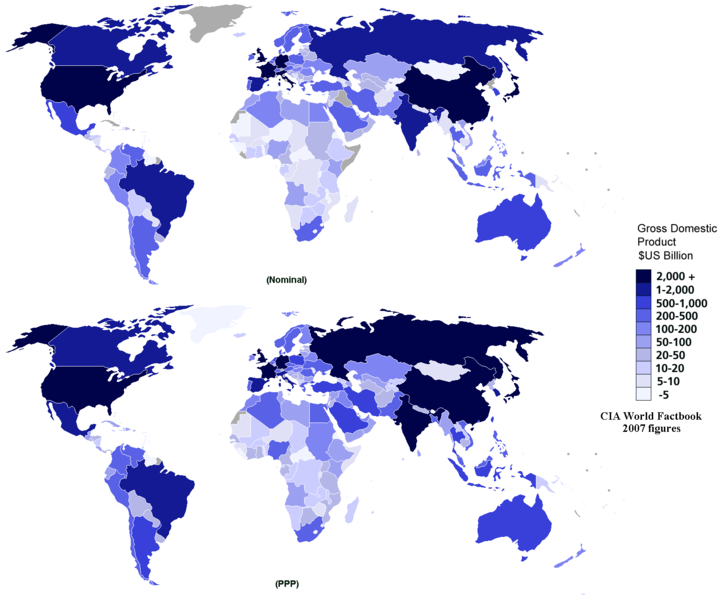
There are two methods of GDP calculation: nominal GDP attempts to compare countries using current exchange rates to give an assessment of their clout within the global market. Purchasing Power Parity or PPP GDP, on the other hand, tries to take into account that one dollar can buy more in some countries and less in others. It is a better gauge of the internal size of each market.
In the nominal GDP method, we can see that the developed world leads the pack, but that China has already broken into this exclusive club.
When we look at PPP GDP, China, India, Brazil and Russia are all within the top 10.
Here is the Top 10, as listed by PPP GDP:
This map from the CIA World Factbook will help to illustrate the differences between calculating world GDP figures on a PPP or nominal basis.
For an analysis on nominal GDP comparisons read our article on World GDP.
A sectoral analysis of country GDP allows us to understand the paradigm shift now occurring within most world economies. Growth patterns generally show a shift from agriculture to manufacturing and ultimately to the services sector.
The following table shows the percentage of GDP contributed by each sector in the top ten economies of the world:
The growth rate of these economies is also an important factor, and is directly related to the overall development of a specific economy. Group of Seven Countries such as the United States, France, Italy and the United Kingdom all typically have smaller growth rates – usually in the region of about 2% per annum.
By contrast, emerging economies such as India and China have growth rates of around 8% to 11%, while the ‘new’ emerging economies may experience even more blistering growth rates. Developed countries have already reached a saturation point, and thus expand less than emerging economies, where possibilities and opportunities are ripe, investors are ready to take risks, and consumers are demanding more goods and services than ever before.
There are two methods of GDP calculation: nominal GDP attempts to compare countries using current exchange rates to give an assessment of their clout within the global market. Purchasing Power Parity or PPP GDP, on the other hand, tries to take into account that one dollar can buy more in some countries and less in others. It is a better gauge of the internal size of each market.
In the nominal GDP method, we can see that the developed world leads the pack, but that China has already broken into this exclusive club.
When we look at PPP GDP, China, India, Brazil and Russia are all within the top 10.
Here is the Top 10, as listed by PPP GDP:
| Ranking | Country | Approximate GDP- Purchasing Power Parity |
| 1 | United States of America | $13,860,000,000,000 |
| 2 | China | $7,043,000,000,000 |
| 3 | Japan | $4,305,000,000,000 |
| 4 | India | $2,965,000,000,000 |
| 5 | Germany | $2,833,000,000,000 |
| 6 | United Kingdom | $2,147,000,000,000 |
| 7 | Russia | $2,076,000,000,000 |
| 8 | France | $2,067,000,000,000 |
| 9 | Brazil | $1,838,000,000,000 |
| 10 | Italy | $1,800,000,000,000 |
This map from the CIA World Factbook will help to illustrate the differences between calculating world GDP figures on a PPP or nominal basis.
For an analysis on nominal GDP comparisons read our article on World GDP.
A sectoral analysis of country GDP allows us to understand the paradigm shift now occurring within most world economies. Growth patterns generally show a shift from agriculture to manufacturing and ultimately to the services sector.
The following table shows the percentage of GDP contributed by each sector in the top ten economies of the world:
| Country | Contribution of Services Sector in GDP (estimated for 2007) | Contribution of Industrial Sector in GDP | Contribution of Agricultural Sector in GDP |
| United States of America | 78.5% | 20.6% | 0.9% |
| China | 39.5% | 49.5% | 11% |
| Japan | 73.3% | 25.2% | 1.5% |
| India | 55% | 28.4% | 16.6% |
| Germany | 69.5% | 26.9% | 0.9% |
| United Kingdom | 75.5% | 23.6% | 0.9% |
| Russia | 56.3% | 39.1% | 4.6% |
| France | 77.3% | 20.7% | 2% |
| Brazil | 64% | 30.8% | 5.1% |
| Italy | 69.3% | 32% | 5% |
The growth rate of these economies is also an important factor, and is directly related to the overall development of a specific economy. Group of Seven Countries such as the United States, France, Italy and the United Kingdom all typically have smaller growth rates – usually in the region of about 2% per annum.
By contrast, emerging economies such as India and China have growth rates of around 8% to 11%, while the ‘new’ emerging economies may experience even more blistering growth rates. Developed countries have already reached a saturation point, and thus expand less than emerging economies, where possibilities and opportunities are ripe, investors are ready to take risks, and consumers are demanding more goods and services than ever before.
Visitors till this post: 22398 visitors
Tuesday, August 04, 2009
Comrade Subhas Chakrabarty Amar Rahey

Tomake Janai Lal Selam
Comrade Subhas Chakrabarty left us on 3rd August, 2009 at 11.35am at the age of 67 at Kolkata. He was born on 18th March, 1942 at Dhaka. He was cremated on 4th August, 2009 at 8.00pm at Keoratala Mahashashan. He was given Guard of Honour by the Police. His death procession was followed and accompanied by lakhs and lakhs of people from different political background.
Subhas-babu, you will remains in the hearts of billions and billions of Bengali for a long time.
Visitors till this post: 19948 visitors
Saturday, April 25, 2009
7 things to Beat the Severe Heat this Summer
1. Plant more trees
- on your backyard, roof, terrace
- on the roadside, footpath,
2. Stop shouting political slogans
- Spend all the money being used in political slogans, plackards to plant more trees,
3. Build more power generating stations
- to reduce shortfall of megawatts of power
- to make the supply more than demand
4. Drink more water, juices, fruits containing more water
- to keep your body cool.
- get rid of dehydration
5. Eat less spicy food
- for better digestion
6. Stop shouting at others or exhanging angry words and stop violence / adopt means of non violence
- to relieve stress
- go to swim
7. Pray to God for rain every night
- as that is the ultimate thing one could do
Visitors till this post: 18413 visitors
Tuesday, April 14, 2009
Predictions of Vaijayanta – Lok Sabha Elections 2009 based on 2004 elections results (West Bengal)
Predictions of Vaijayanta – Lok Sabha Elections 2009 based on 2004 Elections Results in West Bengal
1 – Coochbehar –
2004 – Hiten Barman of AIFB (51.54% votes) beat Girindra Nath Barman of AITC (27.76% votes) by 23.78% votes
2009 - Hiten Barman of AIFB (45% votes) will beat Girindra Nath Barman of AITC (35% votes) by 10% votes
2 – Alipurduars
2004 - Joachim Baxla of RSP (45.7% votes) beat Manoj Tigga of BJP (28.44% votes) by 17.26% votes
2009 - Joachim Baxla of RSP (55.0% votes) will beat Manoj Tigga of BJP (20.0% votes) by 35.0% votes
3 - Jalpaiguri
2004 – Minati Sen of CPM (47.65% votes) beat Parash Datta of AITC (27.36% votes) by 20.29% votes
2009 - Minati Sen of CPM (55.0% votes) will beat Parash Datta of AITC (30.00% votes) by 25.00% votes
4 – Darjeeling
2004 – Dawa Narbula of CPM (44.7% votes) beat Moni Thapa of AITC (33.28% votes) by 11.42% votes
2009 – Jaswant Singh of BJP (70.0% votes) will beat Dawa Narbula of CPM (20.0% votes) by 50.00% votes
5 – Raiganj
2004 – Priya Ranjan Dasmunshi of INC (45.98% votes) beat Minati Ghosh of CPM (41.71% votes) by 04.27% votes
2009 – Deepa Dasmunshi of INC (50.0% votes) will beat Minati Ghosh of CPM (45.00% votes) by 5.00% votes
6 - Balurghat
2004 – Ranen Barman of RSP (44.87% votes) beat Manomohan Roy of BJP (37.18% votes) by 07.69% votes
2009 – Ranen Barman of RSP (50.00% votes) will beat Manomohan Roy of BJP (35.00% votes) by 15.00% votes
7 - Maldaha Uttar
2004 – A.B.A. Ghani Khan Choudhury of INC (48.63% votes) beat Pranab Das of CPM (35.54% votes) by 13.09% votes
2009 – Mausam Benazir Noor of INC (55.00% votes) will beat Pranab Das of CPM (30.00% votes) by 15.00% votes
8 - Maldaha Dakshin
2004 – NA
2009 – NA
9 - Jangipur
2004 – Pranab Mukherjee of INC (48.88% votes) beat Abul Hasnat Khan of CPM (44.7% votes) by 4.41% votes
2009 – Pranab Mukherjee of INC (50.00% votes) will beat Abul Hasnat Khan of CPM (45.00% votes) by 5.00% votes
10 – Baharampur
2004 – Adhir Ranjan Chowdhury of INC (51.24% votes) beat Pramothes Mukherjee of RSP (41.27% votes) by 9.97% votes
2009 – Adhir Ranjan Chowdhury of INC (52.00% votes) will beat Pramothes Mukherjee of RSP (40.00% votes) by 12.00% votes
11 – Murshidabad
2004 – Abdul Mannan Hossain of INC (45.86% votes) beat Moinul Hassan Ahamed of CPM (44.32% votes) by 1.54% votes
2009 – Abdul Mannan Hossain of INC (50.00% votes) will beat Moinul Hassan Ahamed of CPM (45.00% votes) by 5.00% votes
12 - Krishnanagar
2004 – Jyotirmoyee Sikdar of CPM (42.73% votes) beat Satya Brata Mookherjee of BJP (40.54% votes) by 2.19% votes
2009 – Jyotirmoyee Sikdar of CPM (45.00% votes) will beat Satya Brata Mookherjee of BJP (35.00% votes) by 10.00% votes
13 – Ranaghat
2004 – NA
2009 – NA
14 – Bangaon
2004 –NA
2009 – NA
15 - Barrackpur
2004 – Tarit Baran Topdar of CPM (55.7% votes) beat Arjun Singh of AITC (35.01% votes) by 20.69% votes
2009 – Tarit Baran Topdar of CPM (60.00% votes) will beat Arjun Singh of AITC (35.00% votes) by 25.00% votes
16 - Dum Dum
2004 – Amitava Nandy of CPM (49.62% votes) beat Tapan Sikdar of BJP (41.73% votes) by 7.89% votes
2009 – Amitava Nandy of CPM (52.00% votes) will beat Tapan Sikdar of BJP (40.00% votes) by 12.00% votes
17 – Barasat
2004 – Subrata Bose of AIFB (45.2% votes) beat Dr. Ranjit Kumar Panja of AITC (44.02% votes) by 1.18% votes
2009 – Subrata Bose of AIFB (50.00% votes) will beat Dr. Ranjit Kumar Panja of AITC (45.00% votes) by 5.00% votes
18 - Basirhat
2004 – Ajay Chakraborty of CPI (50.97% votes) beat Sujit Bose of AITC (30.91% votes) by 20.06% votes
2009 – Ajay Chakraborty of CPI (50.00% votes) will beat Sujit Bose of AITC (35.00% votes) by 15.00% votes
19 – Jaynagar
2004 – Sanat Kumar Mondal of RSP (55.81% votes) beat Asit Baran Thakur of BJP (27.22 % votes) by 28.59% votes
2009 – Sanat Kumar Mondal of RSP (50.00% votes) will beat Asit Baran Thakur of BJP (30.00 % votes) by 20.00% votes
20 – Mathurapur
2004 – Basudeb Barman of CPM (48.56% votes) beat Radhika Ranjan Pramanik of AITC (39.53% votes) by 9.03% votes
2009 – Basudeb Barman of CPM (45.00% votes) will beat Radhika Ranjan Pramanik of AITC (40.00% votes) by 5.00% votes
(more 22 seats are in the queue)
NOTE: - This survery has been done solely for the purpose of curiosity and interest for elections and there was no intention to harm the sentiments of any party whosoever it is.
Source: - Indian Elections
Visitors till this post: 18155 visitors
Thursday, February 26, 2009
Yeh Hain Maidan, Meri Jaan

 I have some good memories of the Maidan of Kolkata. It was called Gorer Maath then which meant Field of the Fort. Gor means Fort in Bengali and Maath means Field. By fort we refer to Fort Willam which is present on the western side of the Maidan.
As a child, I used to go to the Maidan with my Guggy (my maternal grandfather) in his kochi kolapata (light green) colour Fiat (Premier Padmini) in the 1980s. We used to set off for Maidan from our house at Bowbazar at around 5pm. People who accompanied us were Dilu, Ratan, Ludu-da, Tepi and many more. They used to be my co-players at the limited overs cricket match we used to play at Maidan.
When we wanted to plant the stumps (reminds me of the famous saying by Tony Greig - "From stUmp to stUmp and from wickIt to wickIt") on the ground, mounted police officers (who were actually army men on horsebacks) used to come and used to break our stumps or threaten us to remove the stumps from digging on the ground. Actually the army men were there to look after the safety of the Maidan and thus they used to do rounds and keep a strict vigilance inside around the Maidan to keep a watch on the big Maidan.
There was a triangular field in the middle of the big Maidan where there used to be 3-4 small golf courses with many holes (not the hole of Mint with the Hole) for beginners I guess. I don’t know who used to play golf there but whenever I went there along with cricket kit, I used to take my hockey stick there and tried to hole the ball with my hockey stick and once I did that I had to pick the ball from those holes using my hand after a lot of difficulty as the holes were quite small. I feared if there might be many snakes or rodents which might bite my fingers.
I also used to visit the Maidan with my mummy and daddy from our Park Circus flat on a cab or by our car. As we approached the Maidan from S.N. Banerjee Road, the evening sun from above the Eden Gardens used to shine on our eyes thus making it difficult for us as well as the person who is driving the car to look in front.
As we approached the Maidan, we used to enter the Maidan from Red Road approach (which was both ways then), we felt like we have reached a place filled with fresh air very much comparable to heaven. The whip of fresh air on us made us breathe out lungs out to the fullest. It made us get free from all our tensions and forget all our sorrows and pains.
Thus the visits to the Maidan was so much enriching for us that we used to visit the heavenly place once a week and sometimes twice or thrice a week during vacations.
Thus I could never think of a place in Kolkata better than the Maidan to get myself rejuvinated.
Visitors till this post: 17588 visitors
Wednesday, February 11, 2009
KALKI Avatar : The last Avatar of Lord Vishnu.


In KALKI Avatar, Lord Vishnu will incarnate himself as KALKI, the machine-man, who will come riding his white horse and with his blazing sword in his hands. This is supposed to be a future avatar of Lord Vishnu. At the end of Kali Yuga. (present eon) He will punish all evil doers in this world, destroy this world supposedly and recreate a golden age again. He will behead all individuals who have evil intentions in their mind with his sword.
KALKI is the last of the avatars of Lord Vishnu.
Some sites on him: -
Visitors till this post: 17379 visitors
Tuesday, January 20, 2009
I hate Telephones / Cell Phones / Mobile Phones
Cell Phones are something which I hate to carry but I have to for others who love me. These cell phones keep me engaged for long hours when I could have spent my time doing some fruitful work. But these cell phones make me delay my jobs.
People find me anywhere and everwhere, whenever they like through the help of these cell phones but I often cannot get people whenever I want them to be either becuse their cell phone is off or becuse they are busy doing some important work.
Cell phones make my spend hundreds every month on pre paid bills and thus makes me grow poorer with each day. Because of the cell phones anyone can track me who are sitting on these cell phone offices like Vodafone, Airtel or BSNL can screw me up anytime for any made up reasons.
But lately I have identified a method of making cell phones disturb me less by keeping my cell phone switched off when I am not in the mood of speaking on the cell phone thus making it difficult for people who always got me freely available whenever they liked. Only I switch it ON when I need to contact someone. But most of the time I keep it OFF thus peace had again returned back to my life. Thus I can do what ever I like peacefully without a little object disturbing me by ringing itself when I have concentrated on my work the most.
So I think I have solved the issue quite wisely and on the process I have been sucessful in warding off people who used to call me for no reason actually. I have also informed the people who actually need me to send me an SMS as I keep checking my messages periodically even if my cell phone is switched off.
Visitors till this post: 17100 visitors
Wednesday, November 05, 2008
Barack Obama - President of United States of America (USA)
Barack Hussein Obama is the new president of United States of America (USA) was born in 4th August, 1961. He is from the Democratic Party. He was the US Senator for Illinois. His dad is from Kenya in Africa.
Initially when I heard his middle name as Hussein, I thought he was a Muslim, but he is a Christian. He is an African-American and the first person to be an African-American President of USA. This makes all the Indians living in USA and who have USA citizenship believe that one day they might also have such a noble chance to serve the United States. Thus the people of USA were so much bored with Ex-President George Bush that they have voted some one (read as Obama) who has his name sounding / rhyming with Osama the no one enemy of George Bush. Congrats to Obama the new President.
More Info: -
Visitors till this post: 15160 visitors
Saturday, October 18, 2008
Harrassment by a Shuttle Maruti Van No WB02 - 3151
The driver of a Grey/Ash colour, old, 8 seater Maruti Van (number WB02 - 3151) plying between Exide Stoppage and Karunamoyi in Salt Lake is harassing people. He charges rates double rates during office hours and the people during office hours finding no other solution takes his shuttle and falls his victim. If the charge between Exide and Salt Lake is Rupees 15, he charges Rupees 30 after reaching the destination. The diver is a healthy non guy with a moustache demands that he will start doing "bawal" on the passengers if he is not paid the money he demands.
Initially he agrees with the existing amount with the passengers. After reaching the destination, he demands that he should be paid double the amount at any cost, otherwise he will use his sources to create tension among the passengers and would use unfair means to get double the actual amount.
This is what had happened with me today. Today 18th October, 2008 at 5.45pm I asked this driver waiting at Exide crossing near Haldirams to take me and my gf to Darga Road crossing. I asked him what would he charge for it. He said he would charge Rs. 5 (five) each, so we got into the car and sat on the empty seat. Next people came and sat on the 8 seater Maruti Van. As it got filled, the driver took the car and as Darga Road crossing came, he stopped the car about half a kilometer away from the crossing (shows he had evil intentions) and demanded that I give him Rupees 10 each instead of Rupees 5, otherwise he will not let me and my gf go from there. It was 6.10pm then. Thus he came out of the car and started using slang languages in broken Bengali (he is a non-Bengali as it seemed by his language). I said that I cannot give him more than Rupees 10 for both as he had told me to give Rupees 5 each and we are 2 people so he should take Rupees Rupees 10 from me. But he kept quiet about the matter that he had told me that he would take Rupees 5 each.
I told him that I would like to go to a Traffic Sergeant and settle the matter. So I took him to the Sergent waiting at the Darga Road & Park Circus Connector Crossing near Bridge no 4. I related about the whole incident to the Sergeant. The Sergent was indifferent. He was not interested on the matter and told me that I should not give more than Rupees 5 each to the driver and he left to do his job. In the meantime when I was approaching the Sergeant alone he told my gf that she should pay him the money he demands else he should not let her come to me and said he would use more slang language on me.
Later I saw that I was getting late for my next job and my gf was also tired and was on the verge of weeping. So I let the man go off with Rupees 20 and took his car number, so that I can write this blog and make this post an eye opener about this driver and other drivers who charge more than the actual amount and that too maliciously. (Initially drawing the passenger by telling him about the actual fare and demanding double the fare when the destination is about to be reached). Later when I let the driver go away, the traffic Sergeant came to me and told me why did I give the money to the driver. This showed that how the traffic Sergeant was afraid of that driver and did not help a person in danger along with his companion, instead the Sergeant in fear let the driver go away. This is the condition of Kolkata today. Hope someone listens. Will I not get a proper justice for this? How long will this continue?
I would like to bring this post to the notice of some people: -
1) The Kolkata Police (who are afraid of the main culprits)
2) The Government of West Bengal (who are indifferent)
3) The Transport Department of West Bengal for allowing such morons to do business with old cars.
4) The Unions of Shuttle Cars to let such illegal cars ply the city and demand high transportation charges by such moron drivers.
Visitors till this post: 14387 visitors
Thursday, September 04, 2008
Nano-baadi or Nano-birodhi? Any solution?
Nano-baadi: Anyone for the Tata-Nano-Project. eg: Buddhadev Bhattacharya and his supporters.
Nano-birodhi: Anyone against the Tata-Nano-Project. eg: Mamata Banerjee and her supporters.
Let us look at the whole Singur situation and compare it with a household situation. Let us think of a farm house. Say I (compare to Buddhadev Bhattacharya) am an owner of a farmhouse (compare to Bengal) of 100 acres along with my cousin sister (compare to Mamata Banerjee). I invite my friend say Kalyan (compare to TATA), a person with great wealth, repute and ability to create a workshop of some factory equipment, to my farmhouse so that he can set up a workshop in only 10 acres. (which is only 10% of the whole area) and develop the livelihood of the farmers in my farmhouse.
Previously there were many farmers who used to work in my land and I had allowed them to take 90% of what they cultivated to their home. But now after Kalyan planned to set up the workshop in 10% of the farmhouse, my cousin sister, who was against me for a long time, who also has equal right over my property, comes and protests my move and says that she would not allow Kalyan to set up the workshop there.
Later, my cousin sister changes her decision and demand that my friend Kalyan can set up the workshop in only 6 acres as 6 farmers who worked on 6 acres were willing to give the land for the workshop in the hope of getting a job in the workshop. While 4 acres of the land would have to be returned to the 4 farmers who were unwilling to work for the workshop of Kalyan.
These 4 farmers along with my cousin sister is fighting and protesting in front of the 10 acres and demanding to return 4 acres to them thus hindering the smooth flow of the work processes of the workshop. The rest 6 farmers are happy that they got an opportunity to work for Kalyan’s workshop in the hope of getting a monthly salary of Rs. 20,000 while if they had cultivated the land they would have barely managed Rs. 5000 at most. So now they are unhappy that they are loosing their Rs. 15,000 for the unwanted protests of the 4 farmers.
So what could be done in such a situation? Any help? Any solution?
Tuesday, September 02, 2008
Section 49-O of the Constitution
Today I read this comment in Rediff.com by an individual called Prafull Kumar. It seemed interesting. I did not know that something like this ever existed. It is: -
Section 49-O of the Constitution
Did you know that there is a system in our constitution, as per the 1969 act, in section "49-O" that a person can go to the polling booth, confirm his identity, get his finger marked and convey the presiding election officer that he doesn't want to vote anyone! Yes such a feature is available, but obviously these seemingly notorious leaders have never disclosed it. This is called "49-O". Why should you go and say "I VOTE NOBODY"... because, in a ward, if a candidate wins, say by 123 votes, and that particular ward has received "49-O" votes more than 123, then that polling will be cancelled and will have to be re-polled. Not only that, but the candidature of the contestants will be removed and they cannot contest the re-polling, since people had already expressed their decision on them. This would bring fear into parties and hence look for genuine candidates for their parties for election. This would change the way, of our whole political system... it is seemingly surprising why the election commission has not revealed such a feature to the public.... Please spread this news to as many as you know...Seems to be a wonderful weapon against corrupt parties in India... show your power,expressing your desire not to vote for anybody, is even more powerful than voting... so don't miss your chance. So either vote, or vote not to vote (vote 49-O) and pass this info on...
Visitors till this post: 12803 visitors
Monday, June 09, 2008
2nd Metro Railway in Kolkata
We are going to have a second Metro Railway in Kolkata soon. I would like to discuss the boons and the banes that would follow it: -
Boons: -
1) We can reach Howrah within 15 minutes of Metro Journey from Bowbazar.
2) We can reach Salt Lake (including Sector V) withing 20 minutes from Bowbazar.
3) More people will be moving through this lifeline or East-West Metro Corridor as a result there will be less air and noise pollution in these stretch.
Banes: -
1) At least 100 buildings in B.B. Ganguly Street will collapse like packs of cards.
2) Many insane people will protest the building of the East-West Metro Railway.
3) Construction work will go for at least next 10 years in the new Metro Railway route with severe waterlogging during monsoons.
Visitors till this post: 9721 visitors
Subscribe to:
Posts (Atom)